Introducing the NetAlly LinkRunner 100G: A New Approach to 100G Network Testing
September 25th, 2026
BlogNews
As enterprise networks continue to evolve towards higher bandwidth, 100 Gigabit Ethernet (100GbE) is becoming increasingly important across data centres, enterprise network cores and high-performance infrastructure. But as network speeds increase, so does the challenge of installing, validating and troubleshooting the fibre connections that support them.
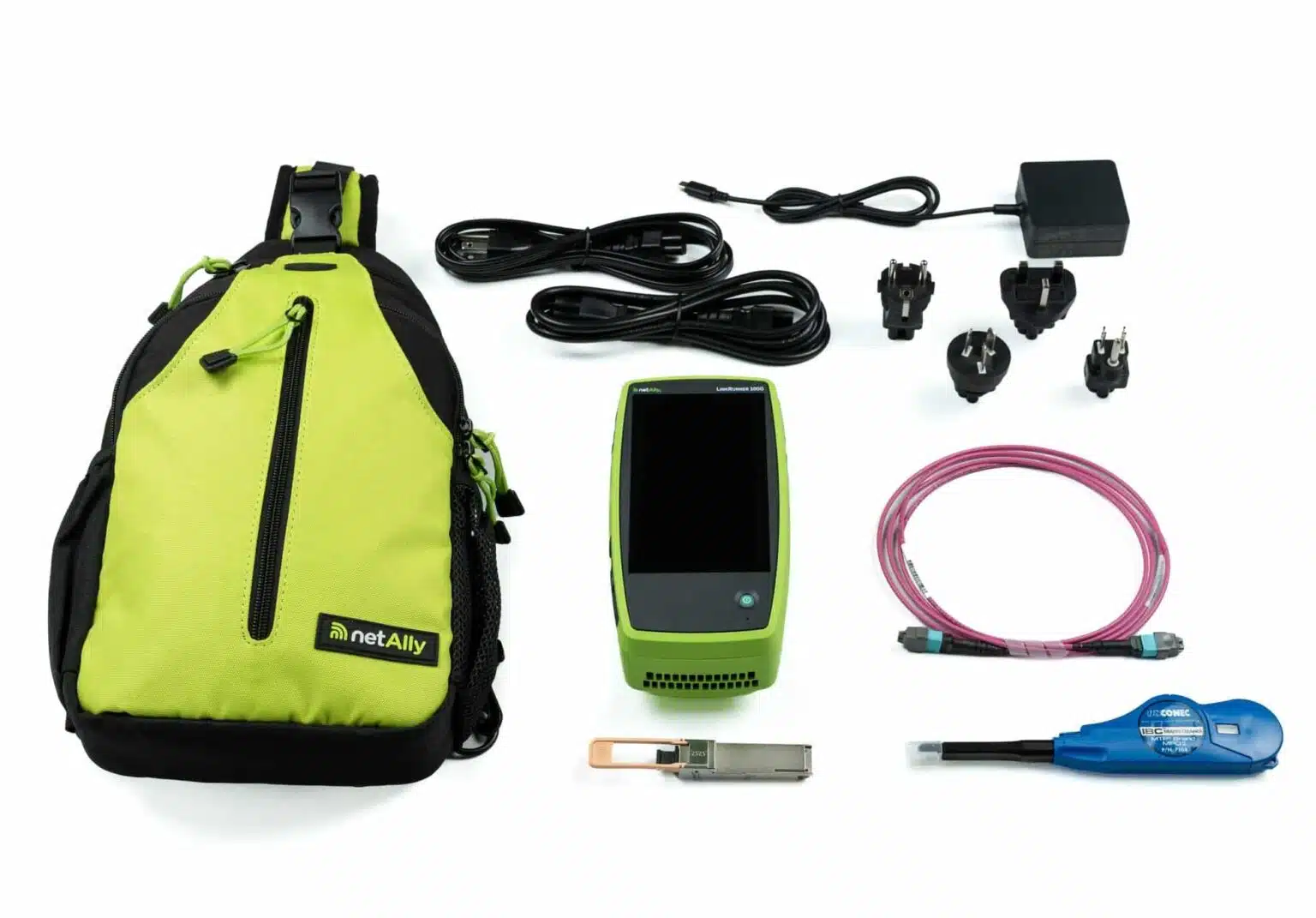
Iris Networks is pleased to highlight the launch of the NetAlly LinkRunner 100G, a handheld network tester designed to help network engineers and IT teams validate and troubleshoot high-speed Ethernet links from 25G to 100G.
Bringing automated testing and detailed diagnostics into a portable device, the LinkRunner 100G helps engineers identify faults, investigate configuration mismatches and verify network performance without relying solely on switch interfaces or specialist test equipment.
For organisations deploying and maintaining high-speed network infrastructure, it offers a practical new way to approach 100G network testing.
Why 100G network testing matters
The move to 100GbE brings significant increases in network capacity, but troubleshooting these connections can be more complex than working with traditional 1G and 10G Ethernet.
High-speed fibre links rely on compatible optical transceivers, correct interface configurations and appropriate Forward Error Correction (FEC) settings. A mismatch in any of these areas can prevent a connection from establishing or cause performance problems that are difficult to diagnose.
In some cases, Forward Error Correction can compensate for transmission errors, allowing a link to remain operational even when its underlying quality is deteriorating.
This means that a link appearing active in a switch interface does not necessarily tell the whole story.
For network engineers, the challenge is to move beyond simply confirming that a port is connected. They need to understand whether the optics, configuration and end-to-end network performance are operating as expected.
The NetAlly LinkRunner 100G is designed to provide that additional visibility, helping teams move from guesswork towards evidence-based troubleshooting.
Introducing the NetAlly LinkRunner 100G
he LinkRunner 100G brings high-speed fibre testing into a handheld device, combining automated validation with diagnostics intended to make complex network issues easier to identify.
Key capabilities include:
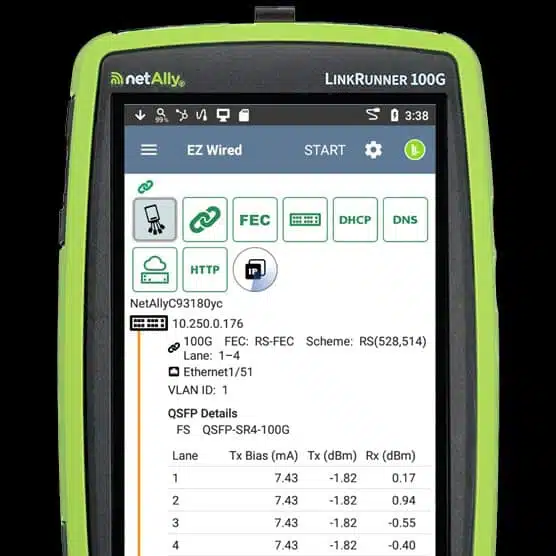
Automated network testing: AutoTest checks link speed, switch port configuration and key network services, providing a quick assessment of the connection.
QSFP28 optical transceiver insights: Identify module types, supported speeds, interface configuration and FEC settings across supported 25G, 40G, 50G and 100G optics.
Fibre and optics validation: Test supported single-mode and multimode fibre connections, including relevant trunk, LC breakout and MTP/MPO configurations.
Network path analysis: Investigate the route to a destination hop by hop to help identify where connectivity or performance issues may be occurring.
Performance testing: Measure throughput, packet loss, latency and jitter using the supported point-to-point performance test functionality.
Centralised reporting: Save and share test results through NetAlly Link-Live to support troubleshooting, handovers and network documentation.
The result is a tool designed to help engineers identify potential faults more efficiently and make informed decisions about where corrective action is required.
As data centres introduce higher-speed Ethernet links, engineers need to verify connectivity before new infrastructure enters production.
The LinkRunner 100G can help validate supported fibre links and optical transceivers, check configuration settings and confirm network performance during installation and commissioning.
This is particularly useful when upgrading network cores, replacing switching infrastructure or introducing new high-speed fibre connections.
By identifying issues before services go live, teams can reduce avoidable delays during deployment and improve confidence in the completed installation.
2. Troubleshooting enterprise network cores
Core-to-ToR measurements provide one view of network performance, but engineers also need to understand how the infrastructure performs across different rack connections.
Rack-to-rack testing extends the process by measuring traffic across paths that traverse the core network and the relevant ToR switches.
Measurements are taken in both directions, helping engineers assess whether performance differs depending on the direction of traffic.
Results from multiple rack connections can then be compared to identify variations and determine whether further investigation is required.
This is particularly important in environments where several customers depend on shared network infrastructure but require predictable, consistent connectivity to the Enterprise networks increasingly depend on high-capacity connections between core switches, distribution layers and critical infrastructure.
A fault on one of these links can affect multiple systems and users, making rapid diagnosis important.
The LinkRunner 100G helps engineers investigate issues such as incompatible optics, incorrect FEC settings, unexpected link behaviour and performance degradation.
Rather than immediately replacing components or escalating every incident to a specialist, technicians can gather diagnostic information to help narrow down the cause and determine the appropriate next step..
3. Validating fibre optics and transceiver compatibility
High-speed fibre connectivity can involve different optical modules, fibre types and interface configurations. A component that appears physically compatible may still be unsuitable for the intended configuration.
The LinkRunner 100G’s QSFP28 Insights functionality helps engineers identify and inspect supported transceivers and their relevant configuration settings.
This can be valuable when commissioning new equipment, investigating a link that refuses to establish or checking replacement optics before returning a connection to service.
Better visibility at the connection point helps reduce unnecessary component swaps and makes troubleshooting more systematic.
4. Proactive maintenance and degradation investigation
Not every network fault results in an immediate outage.
On high-speed fibre links, error correction may mask transmission problems for a period of time. Monitoring the relevant FEC counters and investigating changes in link behaviour can help engineers identify potential degradation before it develops into a more disruptive failure.
The LinkRunner 100G provides visibility into FEC configuration and counter information to support this investigation.
Used as part of a wider maintenance process, it can help teams investigate suspect connections, establish a baseline and document the results of remedial work.
5. Proving network performance after installation
A connection being operational does not automatically mean it is delivering the expected performance.
Following an upgrade or installation, network teams may need evidence that a path is meeting its performance requirements.
The LinkRunner 100G’s point-to-point Performance Test can measure throughput, packet loss, latency and jitter across supported IPv4 network paths. Performance testing requires compatible endpoint equipment, so the appropriate test setup must be planned in advance.
This makes the device useful for validating new infrastructure, investigating user-reported performance problems and documenting results after network changes.
Designed for enterprise IT teams
High-speed network testing has traditionally been associated with specialist equipment and experienced test engineers. However, enterprise IT teams are increasingly responsible for infrastructure that extends beyond the traditional 1G and 10G environment.
A portable tester with automated workflows can help make advanced diagnostics more accessible to network support teams, field engineers and infrastructure specialists.
The LinkRunner 100G also supports the NetAlly Link-Live platform, providing a central location for storing and sharing test results. This can help teams maintain consistent records, communicate findings between engineers and provide evidence of completed validation.
For organisations managing multiple sites or supporting complex enterprise environments, consistent test procedures and accessible reporting can be just as valuable as identifying the immediate fault.
Bringing 100G network testing into your toolkit
The exchange also has a commercial interest in maintaining predictable network performance across its co-location infrastructure.
Unexplained latency variations can lead to customer complaints, time-consuming technical investigations and additional pressure on As 100GbE becomes more prevalent, having the right tools to validate and troubleshoot high-speed fibre connections is increasingly important.
The NetAlly LinkRunner 100G gives network engineers a portable way to investigate optical configuration, validate supported connections and measure network performance. From data centre upgrades and enterprise core deployments to fault diagnosis and post-installation checks, it can help teams approach high-speed network testing with greater visibility and confidence.
Iris Networks can help you assess whether the NetAlly LinkRunner 100G is right for your network testing requirements.
Whether you are planning a 100G upgrade, commissioning new fibre infrastructure or looking to improve your team’s troubleshooting capabilities, contact Iris Networks to discuss your requirements and arrange a product demonstration.
Iris Networks supplies network testing and validation solutions to enterprise IT teams, infrastructure specialists and systems integrators. We work with leading technology vendors to help customers select the right tools for their network environments.
As organisations prepare for the potential impact of quantum computing on traditional encryption, attention is increasingly turning towards technologies designed…
Post-quantum cryptography is often discussed as a cybersecurity issue. But as organisations prepare for the transition to quantum-resistant encryption, network…